You Are The Weakest Link Goodbye . By , 2001, puffin edition, in english. # link # weakest link # you are the weakest link # you are the weakest link goodbye. Photos from "You're Out!" Reality TV Sendoffs E! Online from www.eonline.com You are the weakest link. You are the weakest link goodbye!. You're browsing the gamefaqs message boards as a guest.
How To Find Area Of Rhombus Using Diagonals. Area = (d 1 × d 2 )/2 sq. Since the rhombus is a parallelogram, it has all the properties of a parallelogram.
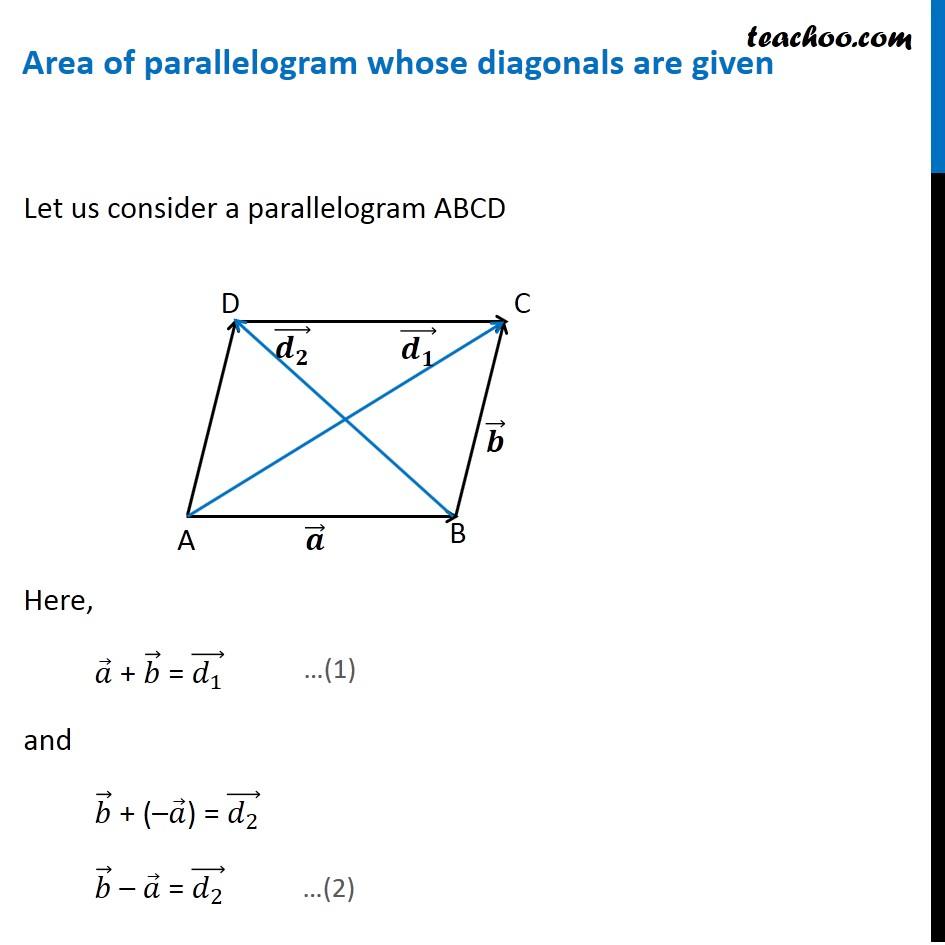
Area of parallelogram whose diagonal vectors are given Vector produc from www.teachoo.com
You’ll get 4 right triangles, with hypotenuse being one side of rhombus, and the legs being half of each diagonal: We have the following information: = 8 × 10 2.
Thus, We Can Consider The Right Triangle To Find The Length Of Diagonal.
Find the diagonal of a rhombus if given side and angle ( , ) : A = d 1 × d 2 2. If our rhombus only has the measurements for the diagonals, this is the formula we would use.
The Diagonals Of A Rhombus Are Perpendicular To Each Other By Making 4 Right Triangles When They Intersect Each Other At The Centre Of The Rhombus.
We have the following information: The perimeter of rhombus with given diagonals are :26 the area of rhombus with given diagonals are :36. Rhombus — is called a parallelogram, in which all sides are equal.
Find The Length Of The Second Diagonal Of A Rhombus If The Perimeter Is 56 Units, And One Diagonal Is 18.
How do we find the perimeter of a rhombus from the diagonals? A = ½ × d 1 × d 2. The figure shows a rhombus within a rectangle.
A Rhombus Is A Quadrilateral With Opposite Sides Parallel And All Sides Equal Length.
Program to find the perimeter of a rhombus using diagonals; Calculate certain variables of a rhombus depending on the inputs provided. If the area of a rhombus is 143 sq.
Rhombuses Have Diagonals That Bisect Each Other At Right Angles.
These formulas for calculating the area of a rhombus are collectively known as rhombus area formulas. There are 3 ways to find the area of a rhombus based on the parameter(s) given. The reverse method is also possible.


Comments
Post a Comment